The Investor Habit Nobody Teaches
The Investor Habit Nobody Teaches

Author Prompt, ChatGPT
In the spring of 2007, Van Tharp walked into our staff meeting carrying a box. He handed each of us a book and said it was Rhonda Byrne’s real “Secret.” The book was The Magic. You may know The Secret, Byrne’s movie and bestseller that swept popular culture in 2006/2007 after Oprah’s coverage. Van found it too surface-level. The Magic, he believed, went deeper, reached further, and delivered something genuinely actionable where its famous predecessor had stayed inspirational. Handing out a book to the entire staff represented a serious gesture from Van. He did it exactly once in all our years together.
That morning introduced me to gratitude as a practice rather than a sentiment. That distinction has shaped how I approach investing ever since.
The Prerequisite Nobody Teaches
Van had already built gratitude into his peak performance framework before that staff meeting. It appeared on his daily checklist alongside other disciplines: self-analysis, visualization, review and several more. Useful task, checked off, moved on.
After he read The Magic, though, something shifted. Gratitude moved from line item to a constant. He started integrating it across our courses on systems, technical analysis, and trading psychology. The emphasis grew heavier. His reasoning crystallized into a single phrase: gratitude functions as a prerequisite for peak performance.
Most investment education focuses on what to do. The mental state an investor brings to any decision rarely gets a mention. Van understood that gap. Fourteen years of teaching alongside him in courses about systems and psychology taught me the same thing from a different angle: the quality of any decision correlates directly to the quality of the state producing it.
Reactive Versus Creative
About ten years ago, I watched a large investment position drop 15% and hit the historical worst-case drawdown threshold my system defined. The loss represented a significant hit to my portfolio. My faith in the system that opened the position had run high. On the day I exited, my frustration ran quite a bit higher.
Gratitude occupied some distant galaxy from my mental state that afternoon.
Later, that hard day made something clear to me. Gratitude comes easily in a bull market when the portfolio climbs. Feeling grateful for your single biggest loss, in the moment it happens, takes something more than I had developed. That goes for most of us, I suspect. That afternoon, adrenaline ran the show. Appreciation never entered the building.
David Hawkins mapped human emotional states on a numerical scale, from the lowest states like shame and fear up through courage, acceptance, and eventually what he called enlightenment*. Fear and scarcity dominate the lower range and they produce a narrow response set: flee, fight, or freeze. That describes most reactive investing behavior precisely. Someone entering a sell order before the market opens based on a worrisome headline. Someone fighting a strong trend by exiting on the first wobble. Someone paralyzed and staying in cash when every rule says buy. I recognize all three because I've been all three.
Gratitude aligns with the acceptance range Hawkins placed around level 350. Van believed that 350 represented something of a minimum operating level for creating consistent success in the markets. A gratitude practice won’t place anyone permanently at 350. It can interrupt the states pulling us toward flee, fight, or freeze long enough to make a clearer decision.
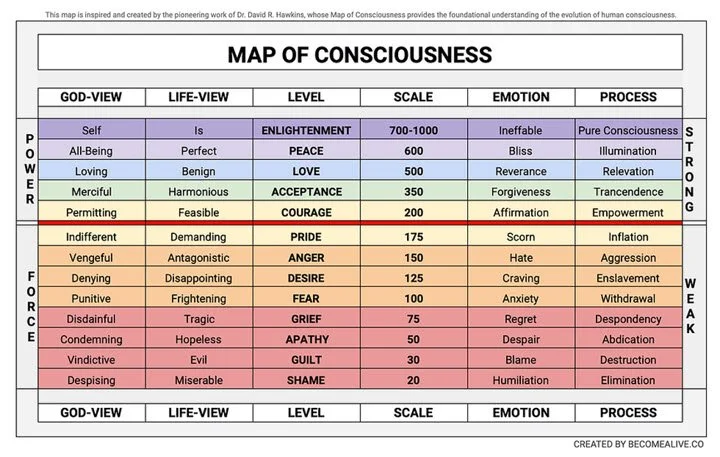
Source: https://www.becomealive.co/product-page/map-of-consciousness-by-david-r-hawkins (no affiliation)
Looking back later at my big loss with some distance, I found something unexpected. Gratitude eventually arrived. I came to feel grateful that my system had defined the limit in advance and that the rules had prevented me from doing something worse in that frustrated state. The loss happened and greater damage stayed off the table.
Two Interruptions Working at Different Scales
Gratitude interrupts the emotional scarcity and fear response. Rules-based investing interrupts emotional market responses. They work through a similar mechanism at different scales.
Neither a gratitude practice nor a systematic approach predict what the market will do tomorrow. But both accomplish the same thing: preparation. They put us in a clearer state for whatever arrives. Prepare, don’t predict.
Think about two investors following the same rules, looking at the same screen on the same morning, facing identical market conditions. One arrives full of fear and scarcity. The other arrives grounded. Everything looks the same from the outside but what happens next probably diverges considerably. The mental state determines whether either investor actually follows the rules.
A Practice, Not a Personality Trait
Let me address something that puts off a lot of analytically minded people. Gratitude can sound like optimism or positive thinking. It might come across like a personality trait you either have or you don’t. None of that is accurate. Think of it the way you think of risk management. It’s a discipline. You practice it however you feel because skipping it carries a cost.
My own practice requires one line at the end of each day. I write three things I’m grateful for. That’s it. Some days the entries run deep, the kind of gratitude I feel for my wife in the way Paul McCartney tried to capture in Maybe I’m Amazed. Other days they stay small like the gravel on the side of the Wade Avenue exit ramp. That one surprised me. Something completely forgettable holds a purpose and deserves its place in the universe. Hawkins referred to appreciating the perfection of something just as it is. Sitting with a thought like that for thirty seconds shifts my state noticeably.
The practice doesn’t follow me to the screen as a pre-trade ritual. Over time, it raises the floor. The baseline state I bring to a signal review or a position decision runs calmer and clearer than it did before the practice existed. That residual effect may matter more than any single moment of gratitude. The practice, it turns out, also changes what we notice when we look at the markets themselves.
What the Market Actually Provides
Extensive travel outside the United States has a way of re-calibrating what feels ordinary. Most Americans who have stayed close to home lack an appreciation for what domestic capital markets actually represent. We treat the ability to buy a share of a Fortune 500 company as trivial, even beneath notice.
Consider what has to exist for such a transaction to happen. A legal structure that recognizes private ownership in an enterprise. An exchange that enforces fair dealing among strangers. A regulatory framework that holds companies accountable to shareholders. Institutional trust deep enough that people put their capital at risk alongside people they’ve never met. Each of those pieces took generations to build. Many countries around the world have attempted to create some version of this architecture. Few have managed all of it simultaneously.
Every S&P 500 company operates globally. When we invest in one, we connect to customers, supply chains, and economies spread across the planet. My little account participates in something genuinely vast. Yes, the market carries dislocations, inefficiencies, and injustices alongside everything else, yet somehow it functions and moves things forward. Imperfect as it is, I find myself grateful for what it provides, even when that means absorbing a loss in the short term, because I know that following my rules over time generates results I couldn’t produce through pure intuition.
Many people around the world lack access to this, for reasons entirely outside their control. Sitting with that awareness generates a gratitude that changes the texture of a down day.
The Signal Worth Paying Attention To
Gratitude tells us something the charts never will. It reads the state we bring to the decision, whether that involves developing a system, reviewing a methodology, or executing a signal. We check the charts. We rarely check the state we brought to them.
So here’s a question worth sitting with. What does your morning look like before the first chart loads? Does anxiety show up first, or something closer to appreciation for the chance to participate at all?
Want more guidance like this? The Growth Guardian Investor newsletter is free and built for self-directed investors approaching retirement.
Important Disclosures
This article is for educational purposes only and does not constitute investment advice or a recommendation to buy or sell any security. Investing involves substantial risk, and past performance does not guarantee future results. Mentions of any system or methodology are illustrative, not advisory.
Full Disclaimers Statement on www.gginvestor.com.