The Market Looks Fine. Does It Feel That Way?

Author Prompt, ChatGPT
The Market Looks Fine. Does It Feel That Way?
Picture the moment. You open your second quarter statement and another green number stares back. You feel relieved. Then a flicker of doubt shows up right behind it. Most people bury that flicker and keep scrolling. The smart ones stop and pay attention. So look at what that calm is hiding. The Shiller P/E sits at forty-two. A handful of AI names now make up roughly forty percent of the S&P 500 index. Those same few names are doing the heavy lifting, growing earnings more than twice as fast as the other 493 combined.
The surface looks fine. The structure looks stretched. That gap, between how it feels and what the numbers say, raises a mid-year question worth asking. When the market moves, will you react to it, or will you already know your response?
To answer that, look past your own statement where the picture starts looking more tangled. Since it bottomed in March 2009, the S&P 500 has climbed more than tenfold. Even the two real drops since then, in 2020 and 2022, came back so fast that a whole generation of investors learned to treat every decline as a quick detour. Some analysts watch historical market cycles and warn about a potential snapback. Meanwhile, the money supply keeps growing, propping up prices everywhere. The Fed could go either way next and no one's sure which. Ray Dalio built the world's largest hedge fund reading cycles like these and now warns that the great powers have entered the early stages of a world war. In the middle of all this, a quiet number stands out. Morningstar nudged its safe withdrawal rate up to 3.9 percent, not because stocks are safer but because bonds finally pay close to what stocks might return over the next decade. Underneath the headlines, more signals lean the same way, toward risk. So in a market like this, preparing beats hoping.
Hoping counts on the market climbing forever. The clearest reason it won't comes from Ed Easterling, a name you won't see on financial TV. He runs a small research shop far from Wall Street, and he reads the market's long cycles in a way the headlines never bother to. His whole idea is simple. The market's price comes down to two numbers multiplied together: what companies earn, and how much investors will pay for each dollar of those earnings, what we call the P/E ratio. Earnings grind higher slowly. The P/E swings hard, and it swings on inflation, climbing when inflation stays calm and falling when it runs hot. The cycles run on plain math, not magic.
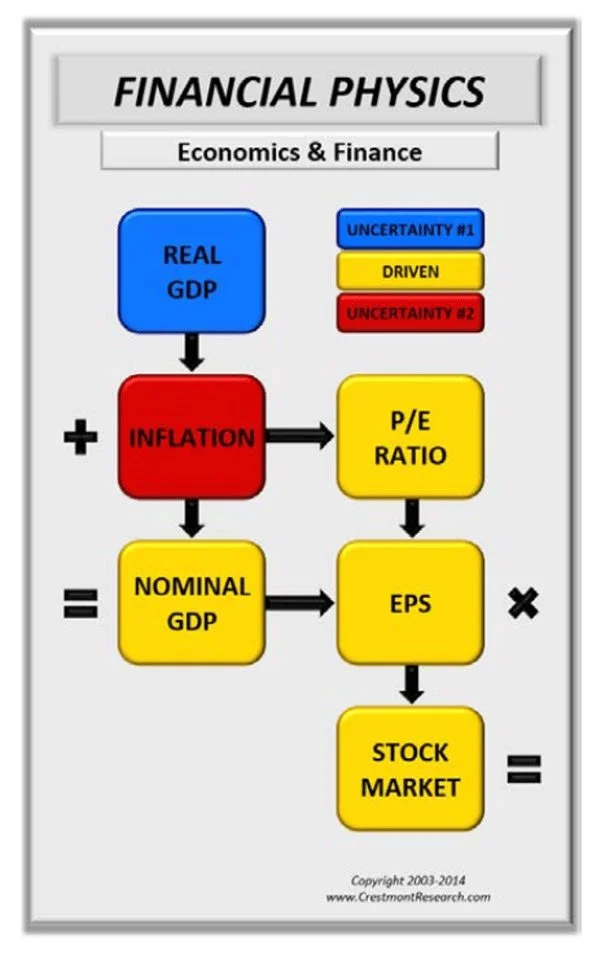
Right now, investors pay forty-two dollars for every dollar of earnings, near the all-time high in December, 1999 and second highest in a hundred years. Prices like that can only stretch so far. From here, earnings have to do nearly all of the work in a market that's betting everything on one story. If you're anywhere near retirement, that math can bend your timeline, not just your mood.
Which way the market breaks is anyone's guess, so stop trying to predict it and start planning what you'd do in each of three scenarios. In the first, the melt-up keeps rolling and stretches prices even further, tempting investors to pile in near the top. In the second, the market drifts sideways for years while that high P/E slowly deflates, and buy-and-hold investors get stuck with a decade of disappointing returns. In the third, the snapback hits, prices drop hard, and the long climb back begins. The fall stings right away, but the real damage comes in the years you lose clawing back to breakeven. You can survive all three, but only if you craft your response while you can think clearly. Wait, and you could end up deciding in the moment instead, with your stomach dropping and your account bleeding, the worst possible time to think straight.
Two investors can face the same falling market and walk away with opposite results. The difference comes down to how each one sees their role, not how much information they have. The victim treats the market as something done to them. They wait to see what happens, then react while fear runs the controls. Morningstar’s Mind the Gap report even put a number on it, the 1.1 percent a year the average investor gives up to bad timing.
The creator starts from a colder, more honest place. You can't control which scenario shows up. You can control your rules, the drawdown you refuse to cross, and the response you set before the market rolls over and keeps grinding lower. The creator feels the same unease. The feeling flags the danger, the rules decide the move. Managing your own money means owning the outcome, instead of handing it to someone whose process you never really see, and can't check once a bad quarter turns into a bad year.
On paper, the math backs a disciplined, systematic approach. The bigger reward, though, arrives quietly. You lay down the need to be right, the rush when you nail it, and the gut-punch when you don't.
Prepare, don't predict. It sounds simple, and it works because it holds up across every path, instead of betting everything on one. You can't know which scenario the second half brings. You can decide right now, however, how you'll handle each one. Write that decision down as rules, then follow it without flinching, and you've got the same discipline the SmartSignal System turns into a simple monthly habit, rules drawn from how markets have actually behaved rather than from anyone's forecast.
The second half of 2026 will do what it does. How you meet it, as a creator or a victim, that part is yours.
https://www.multpl.com/shiller-pe
https://www.fool.com/research/magnificent-seven-sp-500/
https://finance.yahoo.com/news/magnificent-seven-2026-earnings-view-195939316.html
https://finance.yahoo.com/markets/stocks/articles/just-3-companies-drive-70-145717948.html
https://www.fool.com/investing/2026/04/16/how-long-does-the-average-bull-market-last-heres-w/
https://www.morningstar.com/retirement/whats-safe-retirement-withdrawal-rate-2026
https://www.morningstar.com/business/insights/research/mind-the-gap
https://www.crestmontresearch.com/docs/Financial-Physics-Presentation.pdf
https://time.com/article/2026/04/09/ray-dalio-we-may-be-entering-a-world-war/
***
Want more guidance like this? The Growth Guardian Investor newsletter is free and built for self-directed investors approaching retirement.
Important Disclosures
This article is for educational purposes only and does not constitute investment advice or a recommendation to buy or sell any security. Investing involves substantial risk, and past performance does not guarantee future results. Mentions of any system or methodology are illustrative, not advisory.
Full Disclaimers Statement on www.gginvestor.com.