Are You An Investor Or Someone Who Owns Investments?
Are You an Investor - Or Someone Who Owns Investments?
Every month or three, Marcus logs into his brokerage account, checks the balance, and feels a little relief or dread depending on the numbers. He has a 401(k), a Roth IRA, and a dormant brokerage account he opened during COVID when everyone seemed to be making money. He checks Yahoo Finance headlines. He knows what the Fed has been doing. He could tell you generally where the S&P sits.
Marcus owns investments.
But ask him to describe specific rules that govern his investing decisions? He goes quiet.
Does owning investments make you an investor?
The question probably sounds ridiculously simple but the honest answer rarely is. You won’t find the distinction in a portfolio pie chart. It lives somewhere deeper.
Where Behavior Actually Comes From
Most of us learned to think about investing as a set of actions. Buy. Hold. Rebalance. Diversify. Those actions matter. But actions flow from somewhere deeper – based on our beliefs.
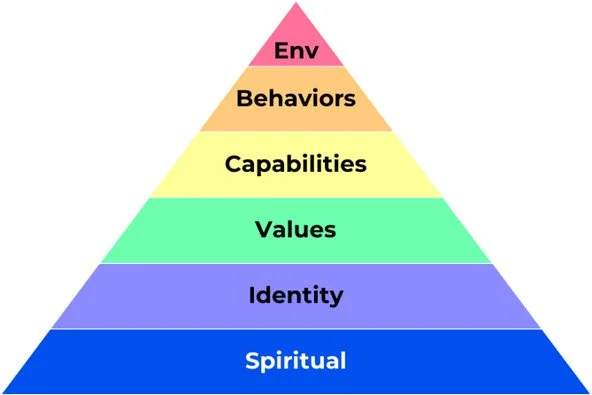
Behavioral change follows a hierarchy of beliefs. At the top sit environment and actions — what's happening around you and what you do in response. Below those come capabilities and values. Toward the bottom of the pyramid sits identity - the stories you carry about who you fundamentally are. Identity has great power and shapes everything above. Try changing a behavior without touching the identity, and the old pattern tends to reassert itself.
This helps explain a puzzle that confuses a lot of smart people. They've read books, attended webinars, run the numbers. They know what to do. And yet, when markets get turbulent, a gap between their knowledge and their behavior opens up - and they find themselves doing the opposite of what they know they should. This behavior gap seems to be how humans operate – myself included.
Knowledge alone won't close the gap. When we work at the identity level, we have a much better chance for lasting change.
Two very different experiences of the same market
Someone who owns investments tends to experience the market as “happening to them”. A good quarter feels lucky and a bad quarter feels threatening. Market action and financial news, a hot tip by a colleague, or a gut feeling that shifted – those inputs tend to influence or drive investment decisions. General intentions toward long-term thinking may seem important, but if (when) a position or the market drops by 10% or more, those intentions lose a lot of importance.
An investor - someone who operates from an investor identity – has exposure to the same market, the same headlines, hot tips, and gut feelings – but they experience those differently. Not because they know more. Instead, they relate to the process of investing differently. They bring a framework and apply it to each input, to each decision. They define rules long before conditions get emotional. For example, when the markets get volatile, they respond from within a systematic approach rather than reacting to the feelings. They understand that consistency, not brilliance, drives results over time.
As a result, major differences develop between investors and people who own investments: in awareness, in commitment level, and ultimately in outcomes. Those differences don’t always surface in the short run but reliably, they emerge over the years.
The Crutch I Had to Name
For fourteen years, I taught fund managers, professional traders, and self-directed investors how to approach the markets systematically. Some students managed small amounts, others managed nine-figure portfolios. They told me regularly that I finally made this stuff make sense.
Meanwhile, my own retirement money sat in money market funds essentially doing nothing.
I had the funds, the knowledge, and the capability to be an investor. What I didn't have - what I kept avoiding - was execution. And the reason, if I'm honest, was perfectionism. I kept waiting until the research felt sufficient, the conditions looked great, and the systems seemed rock solid. So I'd research, re-run numbers, find another reason the plan was incomplete. I’d do anything to avoid pulling the trigger on something that hadn't yet reached some imaginary threshold of readiness.
What finally shifted wasn't a rock solid system or a finished plan. I gave up on perfection or even feeling completely ready. Instead, I just started executing - imperfectly but smartly and deliberately, without waiting for full certainty (which was never going to arrive anyway). As uncomfortable as that was at first, great results followed. Those results did something the research and planning never could: they built the investor identity.
Worth noting - I never sat down and consciously decided to adopt an investor identity. I just started acting like one. The identity emerged from the results, not the other way around. Which suggests that while identity drives behavior over the long run, sometimes the fastest path to a new identity runs straight through imperfect action.
A Few Questions
Have a pen close by? Rather than skimming, answers here tend to be more useful when written down.
· If your portfolio could speak, would it describe a coherent and consistent strategy - or a string of reactions?
· When the market drops significantly, do you feel mistreated, sort of like a victim? Or do you feel like a practitioner managing risk?
· Could you describe your defined, repeatable framework for making investment decisions?
· Think about the last time investing felt uncomfortable - did that discomfort come from the market - or from following a pre-defined rule (even though that felt uncomfortable)?
Where This Leads
Investing as an investor doesn't necessarily require a complete overhaul of everything you're doing. It often starts with one decision made differently - not from impulses or anxieties, but from a framework you've chosen in advance.
Systematic investing delivers exactly that kind of structure - not a guarantee of perfect returns, but a framework that lets you act as a practitioner rather than ride along like a passenger. Any rules-based system can do that for you. We built the SmartSignal System to be straightforward: clear signals, no guesswork on allocations or position sizing, in five-ten minutes a month.
The question isn't whether you own investments.
The real question: who do you show up as when you manage them?
+++++++++++++++++
To receive helpful information for self-directed investors within 10-15 years of retiring, click here for our free weekly newsletter.
Important Disclosures
Past performance does not guarantee future results. Investing involves risk including the possible loss of principal.
The performance shown combines two different kinds of data. Results from January 2003 through December 2024 reflect backtested application of the SmartSignal methodology to historical price data. Results after January 2025 reflect actual signals delivered to subscribers during that period.
Backtested performance has inherent limitations. It does not represent actual trading. Backtested results benefit from hindsight and do not reflect the impact of trading costs, execution slippage, market liquidity, or the psychological pressures of investing real money during live conditions. For these reasons, backtested performance may differ materially from actual results. Individual subscriber results may also vary based on execution timing, account composition, and other factors.
TenHundred Co., its officers, employees, and partners may hold positions in the ETFs or securities referenced by the SmartSignal methodology, and may trade those positions without notice. TenHundred Co. reserves the right to modify or discontinue the methodology at any time, and past performance data may not reflect the current methodology.
Growth Guardian Investor publishes systematic investing education and methodology training under the publisher's exclusion to the Investment Advisers Act of 1940. We do not provide personalized investment advice. Subscribers make their own investment decisions.
Full Disclaimers Statement on www.gginvestor.com.