
Built For One Market, Not All Markets
Built for One Market, Not All Markets
Since March 31, the S&P 500 has climbed 11% in just 15 trading days. In that stretch, it has had only two down days, reached multiple new all-time highs, and processed convincing volume. On the chart, the price bars appear almost ruler-straight (at least until yesterday).
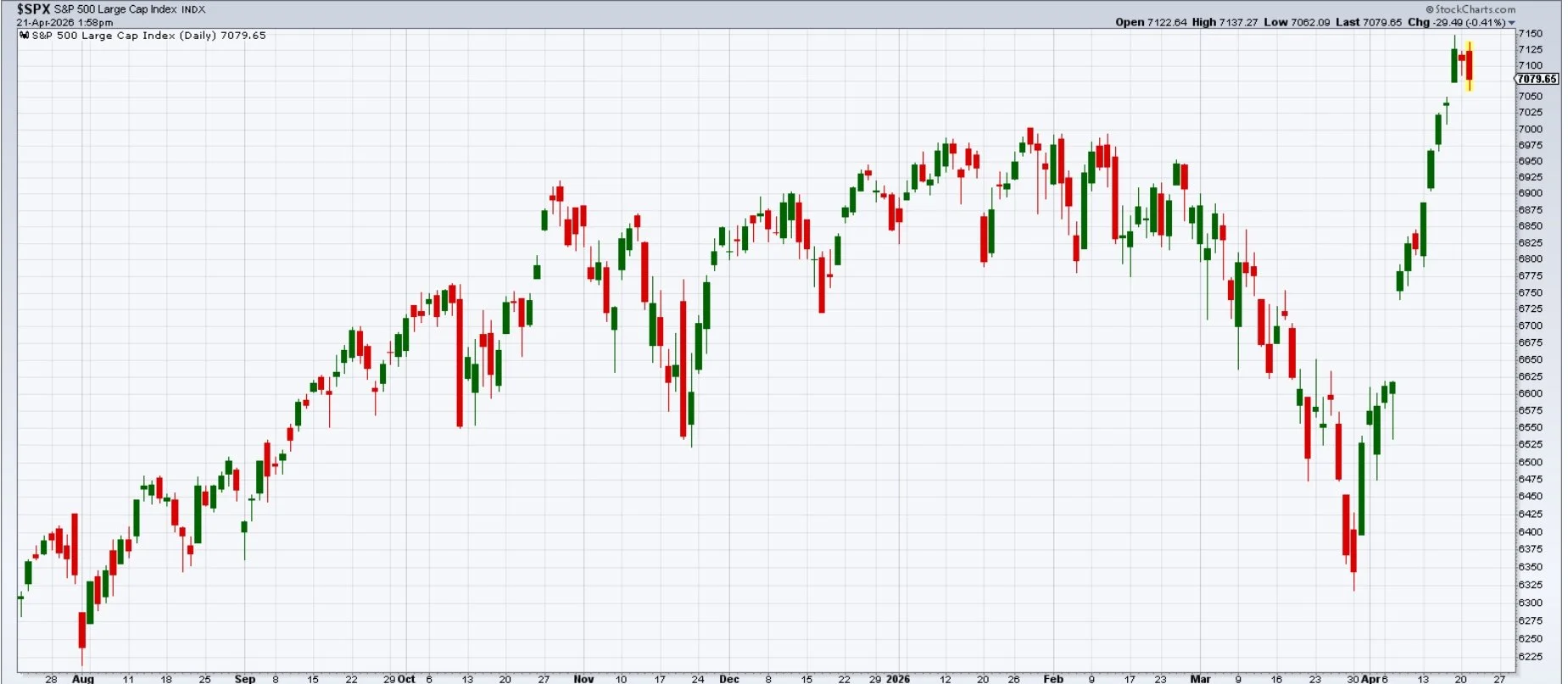
S&P 500 July 24, 2025-April 21, 2026, Source: stockcharts.com
What could end it? The usual suspects: geopolitical shock, inflation scare, Fed pivot, AI earnings miss. But here's the better question: Does the trigger really matter?
The Empirical Playbook
Most self-directed investors have become comfortable operating from a simple script: The market dips. The market recovers. Buy the dip. Things work out!
And who wouldn't believe that? Over the last 16 years, every dip has offered a profitable result in fairly short order. Empirical evidence, not irrational optimism, drives that conviction. Markets have recovered, and recovered fast.
I used to share a similar kind of confidence.
What I Got Wrong
For years, I thought I could read certain market signals well enough to stay ahead. I followed a methodology built on a very few principles upheld as inviolate. I adopted beliefs about these patterns based on a century plus of demonstrated “proof”.
Then one of the principles failed. First time in history – ever!
My financial loss amounted to little but the experience shattered something more valuable: my confidence in the methodology itself. Because if one 'law' could fail, how many others were waiting to break?
After that experience, I stopped trying to predict what comes next and started studying what markets had actually done. I started the shift from predicting direction to preparing for different paths.
The Real Risk
Most plans assume a binary outcome: up or down. Market history offers many paths.
Consider 2000-2002: Instead of crashing spectacularly, the market just kept grinding slowly lower. The first 30% took a full year. Every dip felt like a buying opportunity. Every bounce felt like the beginning of a recovery. But for 18 months, every bounce failed and then the index hit a new low. Investor patience often gave out before their accounts did.
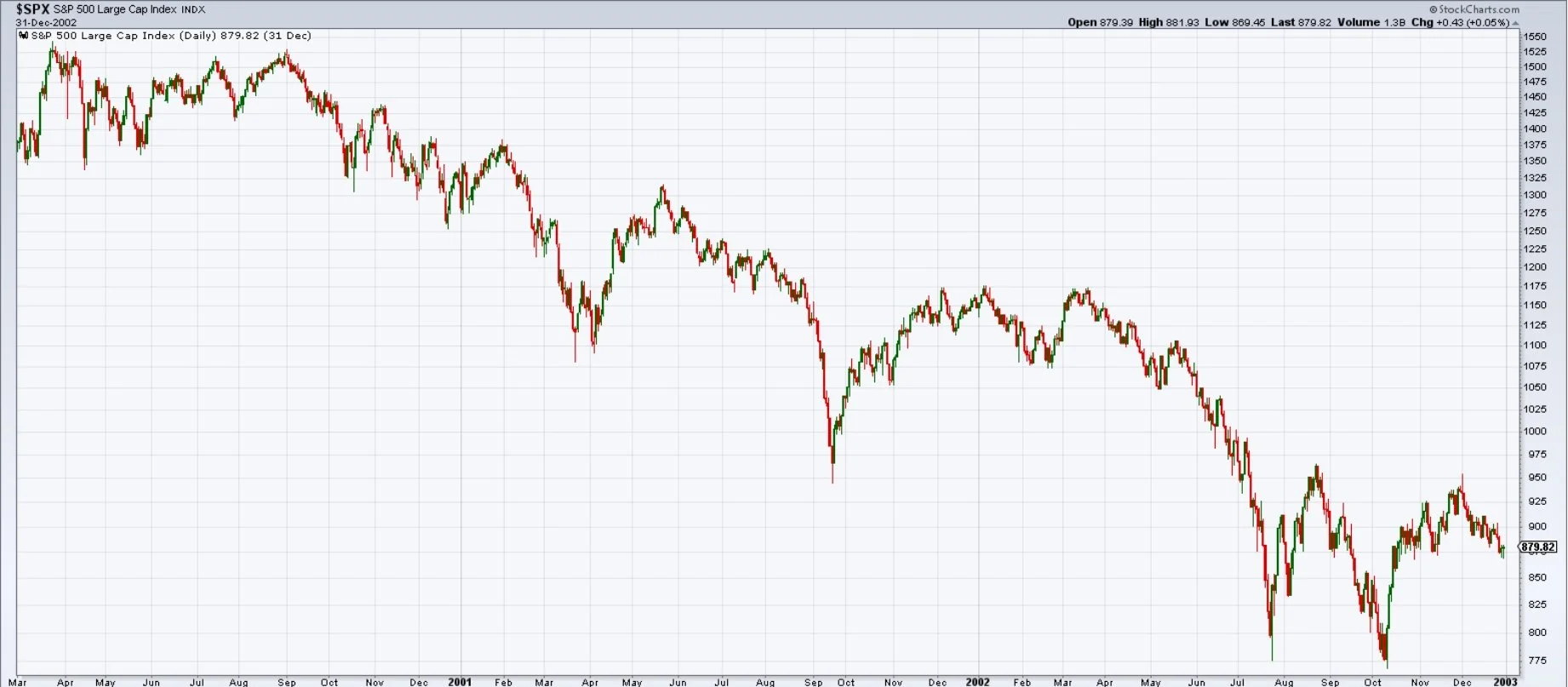
S&P 500 March 2000-December 2002, Source: stockcharts.com
Or consider the late 1960s through the 1970s: multiple huge bull runs and huge bear markets for more than a decade. After all of that? The S&P broke even on a nominal basis – it ended where it had started. Buy and hold investors, however, suffered significant real losses (after inflation) on the order of 60%. Ouch!
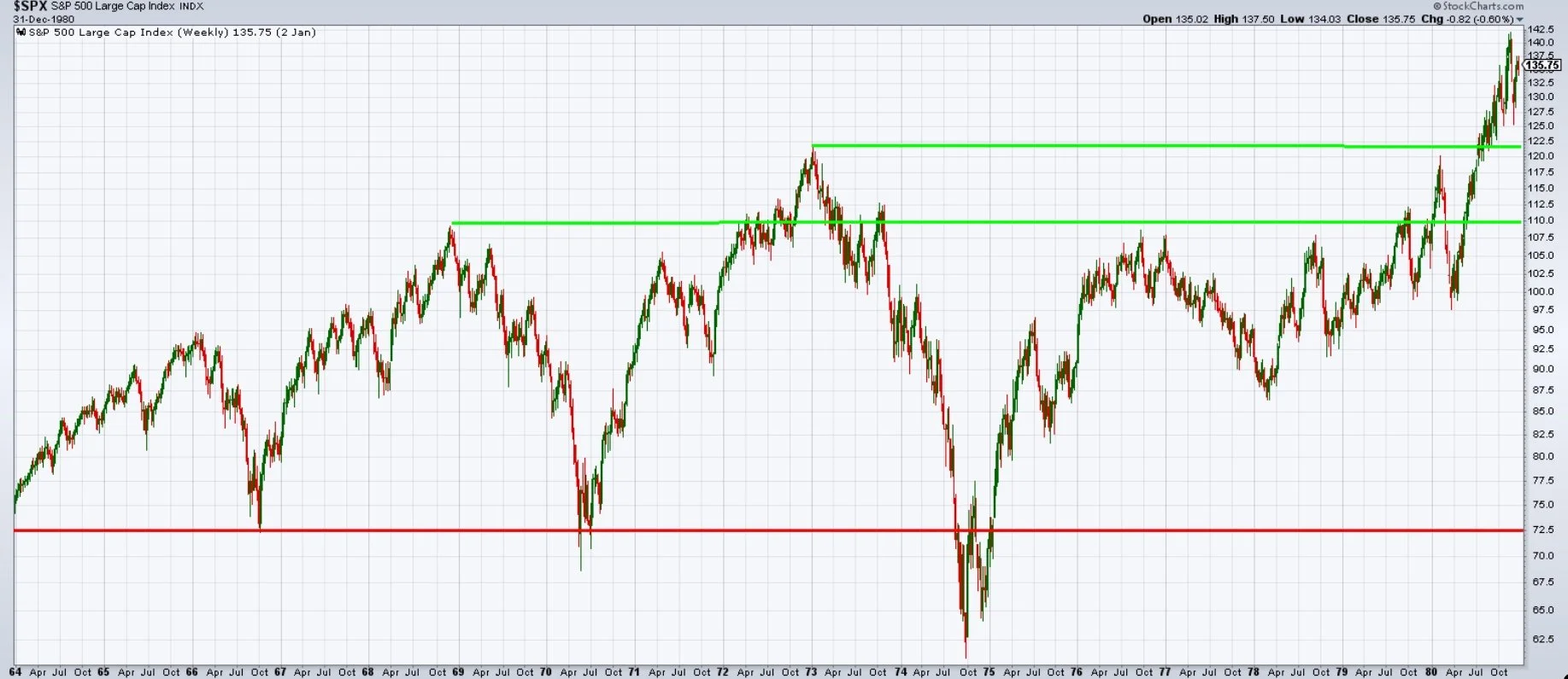
S&P 500 1964–1981, Source: stockcharts.com
If stocks were to start another such flat inflationary type market pattern today (and I’m not saying they will), it would run through somewhere around 2037. If that were to happen, answer two questions:
• How many dips would you buy before you stopped?
• If you're retiring in the next few years, would your current plan survive such conditions?
The Test
Buy-and-hold works... until it tests something the investor hasn't experienced.
If you started investing in 2010, your worst drawdown since then came in October, 2020: 34% down, 15 months to recovery from the bottom. That worst pales in comparison to worst from previous periods.
What happens if the market heads in new directions? Directions we haven’t seen in a long time?
Untested scenarios:
· Decline Magnitude: A 54% drawdown instead of 34%
· Decline Duration: A drop and recovery that takes 5 years instead of 15 months
· Secular Volatility: The market cycles through huge moves up and down for a decade.
Five years for recovery doesn't sound long until you calculate what you lose. If you're 66, you're 71 before breaking even. If you're 55, you just lost half your final accumulation decade. If you're 45, you lost five prime earning and investing years. The specific damage varies by life stage, but the reality remains: time you spend recovering is time you don't spend growing. And that's assuming you didn't need any of that money during those five years.
Preparation, Not Prediction
The next five years could look like another 2010-2015 or 1970-1975 or some other period. Nobody possesses that crystal ball.
But here's what I can tell you: having a systematic process that that adapts to changing market conditions and manages risk exposure changes everything. You stop needing to predict direction. You stop making decisions from fear or greed. Your plan accommodates multiple market scenarios and thrives. You trade prediction anxiety for process confidence.
The danger today: investors who have become comfortable and built plans that function in the market continuing its recent past for the future.
The market just rallied steadily for 15 days straight. It may keep going for a short bit or for a long while. The real test of most plans will come somewhere down the road.
We explore this territory each week through the newsletter and the SmartSignal educational methodology; preparing for wherever markets go, not predicting their destination.
+++++++++++++++++
Want more guidance like this? The Growth Guardian Investor newsletter is free and built for self-directed investors approaching retirement.
Important Disclosures
Past performance does not guarantee future results. Investing involves risk including the possible loss of principal.
The performance shown combines two different kinds of data. Results from January 2003 through December 2024 reflect backtested application of the SmartSignal methodology to historical price data. Results after January 2025 reflect actual signals delivered to subscribers during that period.
Backtested performance has inherent limitations. It does not represent actual trading. Backtested results benefit from hindsight and do not reflect the impact of trading costs, execution slippage, market liquidity, or the psychological pressures of investing real money during live conditions. For these reasons, backtested performance may differ materially from actual results. Individual subscriber results may also vary based on execution timing, account composition, and other factors.
TenHundred Co., its officers, employees, and partners may hold positions in the ETFs or securities referenced by the SmartSignal methodology, and may trade those positions without notice. TenHundred Co. reserves the right to modify or discontinue the methodology at any time, and past performance data may not reflect the current methodology.
Growth Guardian Investor publishes systematic investing education and methodology training under the publisher's exclusion to the Investment Advisers Act of 1940. We do not provide personalized investment advice. Subscribers make their own investment decisions.
Full Disclaimers Statement on www.gginvestor.com.