
SmartSignal System Report - October 2025
The SmartSignal system finished October with a 2.92% return - not too shabby for a month that kept me watching gold's wild ride and the S&P's steady climb. But here's what I'd encourage you to do: look at those numbers and notice how you feel.

It's natural to get a little boost from a positive monthly return. Year-to-date we're sitting at 12.8%, and the twelve-month return hit 16.2%. Those feel good too. But the numbers that really matter are the ones further up the list: a 10.7% compounded annual growth rate over fifteen years, and 12.8% CAGR over five years. Those are the figures that tell me if I keep following the system's rules consistently, then expecting returns in that 10-12% range over meaningful periods would be reasonable. (Past performance does not guarantee future results)
That's why I followed the signal at the end of September even when I felt resistance - gold had had a strong run already, and I worried about buying it near a top.
Gold did exactly what I feared it would do - it shot up 12% and crashed – though it still finished the month with a 3.5% gain. The S&P added just over 2%.
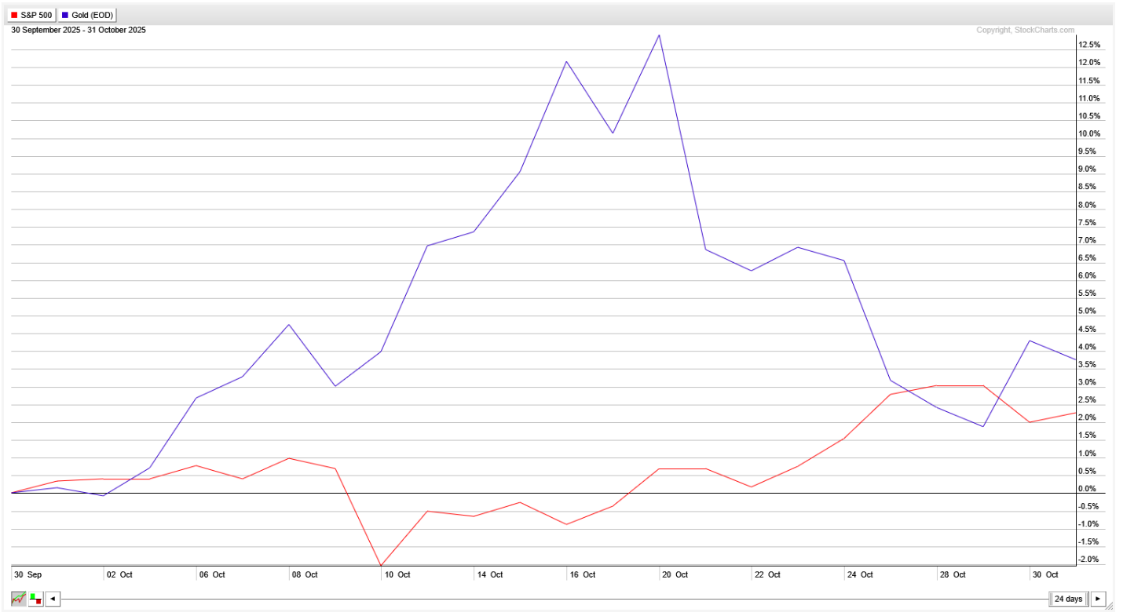
Following the rules isn't always comfortable in the moment, but looking at those long-term numbers reminds me why discipline matters.
Market Conditions: Short-Term Questions, Intermediate-Term Strength
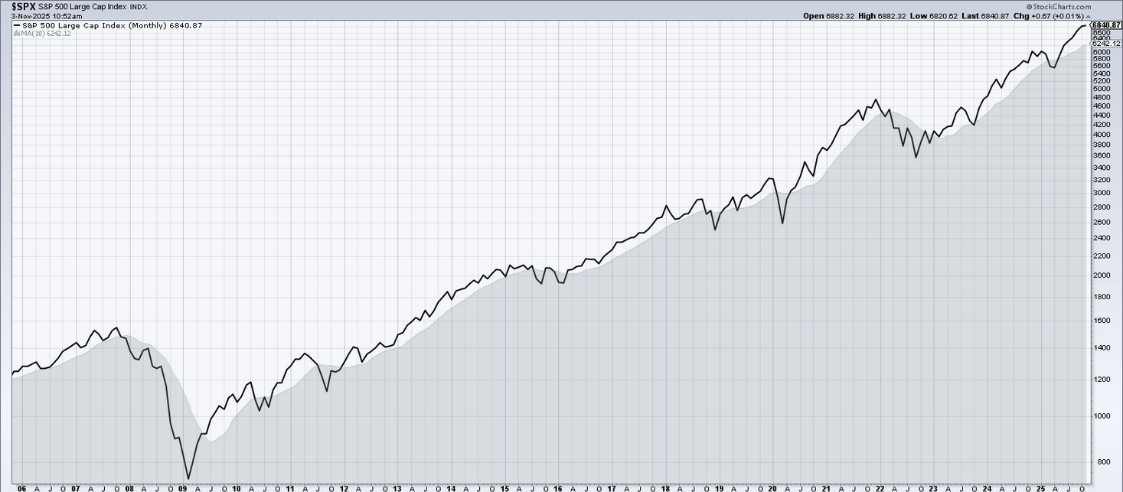
The 20-year log chart still runs from lower left to upper right - that black line might be leveling off or rolling over, but we'll see.
What's more interesting is the five-year chart. Notice the blue line under the price bars in the upper right – the recent few months. When the price hasn’t penetrated that line for more than 100 days, John Hussman pointed out last month that market history says a quick 4-6% pullback can be expected.
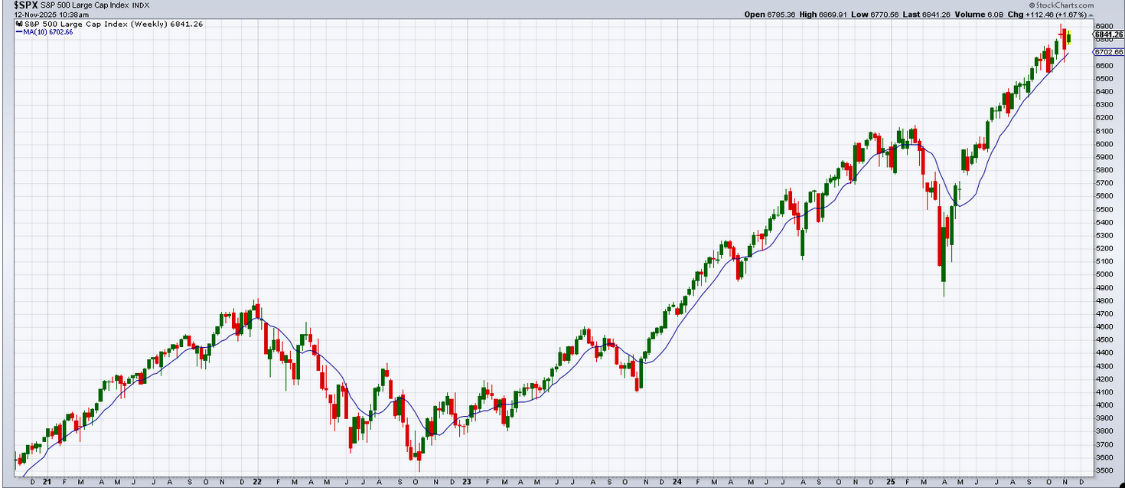
So after 132 days, price pierced the 50 day MA on November 7. The day's low registered a 4.2% loss from the recent high on October 29. Was that the short term pullback? Well, it was a pullback. Hussman may require the market to close below the line, not just poke through it. Either way, not a big concern. The market may let us know soon enough with a new high or another drop.
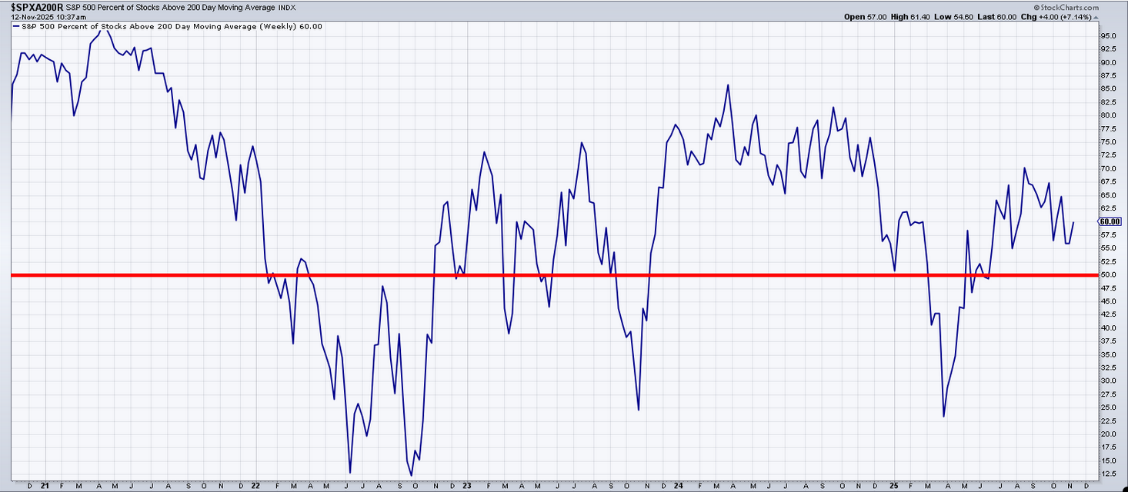
Take a look at the percentage of stocks above their 200-day moving average - still above 50%, declining since September, but in decent shape overall.
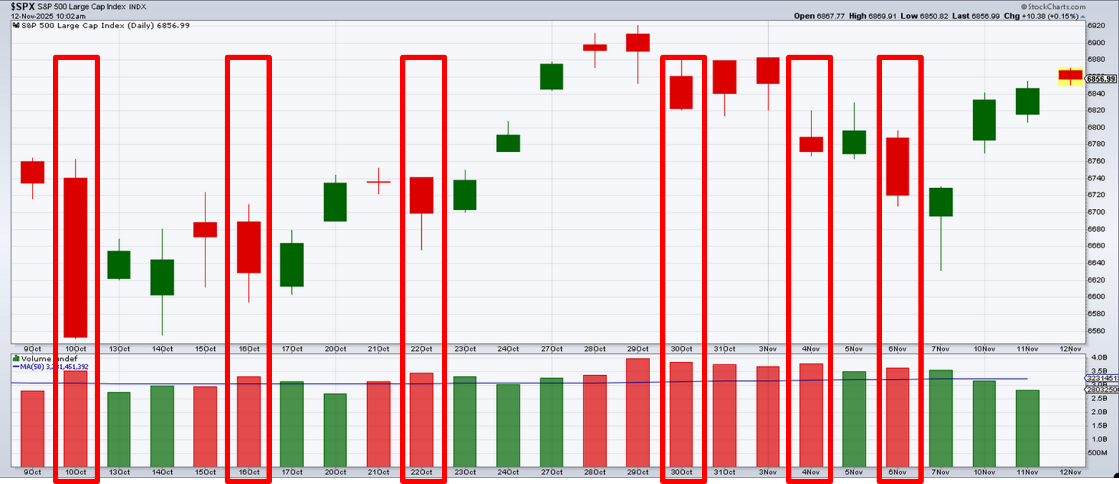
In the chart below, we see six distribution days in the last month. That's not critical yet - it gets more concerning around eight or nine - but let's watch how the next week develops.
The Big Picture: Preparing for What Might Come
John Mauldin publishes a free weekly newsletter at mauldineconomics.com. I'd encourage anybody interested in bigger economic issues to subscribe. There's no affiliation here; I have just found his writing valuable for many years.
Over the last few weeks, Mauldin has been summarizing Ray Dalio's latest book How Countries Go Broke.
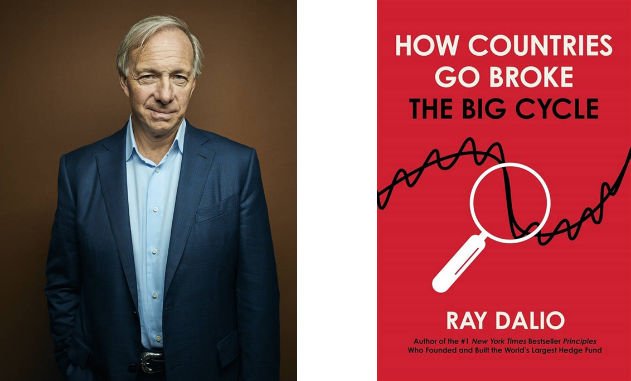
Dalio's research shows that countries and economies move through very long-term debt cycles - 75 to 100 years - and we appear to be ending one of those right now. The massive government debt we're carrying tends to happen at the end of these cycles, and that can trigger economic restructuring and possibly currency devaluation.
Now, he's not saying this is happening next week or next month. Probably a few years out. But if you're looking to retire in the next five to fifteen years, hearing about a global debt crisis can induce some anxiety. I get it. That's a little heavy to consider.
But Dalio didn't write this book to make people panic. He wrote it so people can get prepared. In his newsletter last week, Mauldin wrote about how to think practically about the coming crisis and how to handle it.
He outlined three core principles:
1. It's Not the End of the World
A crisis will likely come, and then it will pass. Focus on the long-term. What has good value today will likely have good value tomorrow. Not what's hot right now - but what's fundamentally sound.
2. Flexibility Will Be Critical
We don't know if the crisis will be inflationary or deflationary, or if the economy will hit both conditions in the coming five to ten year period. That's a huge variable. You want your portfolio able to shift as conditions change.
(This is great news for systematic investors like those who use SmartSignal! Systems that adapt on a frequent basis are likely to fare much better than other strategies so systematic investors are well-positioned for what's likely to come. For committed buy-and-holders, the upcoming period may be much more volatile than past decades. Long holding periods could test patience and discipline in ways we haven't seen in generations.)
3. You May Need Help
For many people - especially those with complex holdings or high net worth - finding a financial advisor who thinks about macro and markets might be useful now. You don't have to do all this yourself. They'd need to demonstrate some ability to understand Dalio's ideas and have strategies ready to apply if these conditions start evolving.
Mauldin also shared what he's doing personally, which you might find interesting:
In equities, he's holding or focusing on high-quality companies with decades of dividends. He wants to own dividend-paying stocks of companies that have been around for a long time. He believes those have the highest chance of getting through the crisis and still being good operations afterward.
He also encourages owning your own business. He's been a small business owner for decades. That gives you control over your ability to generate income from activities where you're engaged and interested.
On gold, he's holding a small portion - 2%-5% is probably fine for most people, he says. I get the sense he's okay with people owning more. You'll hear a lot of people who stress gold holdings in the 5-20% range. He added that if inflation kicks in, everybody's going to wish they had at least half of their holdings in gold - though he thought that would be too much.
(This optimal gold allocation article describes a magic number for gold holdings based on a certain set of assumptions and recent decades data. Their magic number? 18% - not a recommendation, just another data point :-))
Finally, as a high net worth person with many readers also in that category, he's looking at alternative investments: hedge funds, real estate holdings, private credit. He’s also looking to hold some short to mid-term Treasuries. For those of us who are not accredited investors, the most important piece there is probably the short and mid-term Treasuries.
So here's my encouragement: even though these long-term debt cycles suggest rougher seas ahead, nobody's asking you to predict exactly when or how they'll arrive. What matters is that you're not caught off guard. You have time to prepare, and preparing is something we actually do control.
Until next week, take care.
+++++++++++++++++
Important Disclosures
Past performance does not guarantee future results. Investing involves risk including the possible loss of principal.
The performance shown combines two different kinds of data. Results from January 2003 through December 2024 reflect backtested application of the SmartSignal methodology to historical price data. Results after January 2025 reflect actual signals delivered to subscribers during that period.
Backtested performance has inherent limitations. It does not represent actual trading. Backtested results benefit from hindsight and do not reflect the impact of trading costs, execution slippage, market liquidity, or the psychological pressures of investing real money during live conditions. For these reasons, backtested performance may differ materially from actual results. Individual subscriber results may also vary based on execution timing, account composition, and other factors.
TenHundred Co., its officers, employees, and partners may hold positions in the ETFs or securities referenced by the SmartSignal methodology, and may trade those positions without notice. TenHundred Co. reserves the right to modify or discontinue the methodology at any time, and past performance data may not reflect the current methodology.
Growth Guardian Investor publishes systematic investing education and methodology training under the publisher's exclusion to the Investment Advisers Act of 1940. We do not provide personalized investment advice. Subscribers make their own investment decisions.
Full Disclaimers Statement on www.gginvestor.com.