The Investor You've Been… and the Investor You're Becoming
The Investor You've Been… and the Investor You're Becoming
Every major market move probably feels like a decision about money. Buy? Sell? Hold?
Think about early 2009, when markets seemed broken. Or March 2020, when the country shut down all at once. More recently, "Liberation Day" last year. Consider the down market right now. In each moment, you made decisions that may have felt reasonable at the time. Maybe you adjusted exposure, stayed steady, or stepped aside for a while. Each choice made sense in the moment.
But when you step back for a broader view, you can notice something that only see over time – those moments start to line up and they tell a story. Not just about what the market did - but about how you tend to respond when it matters.
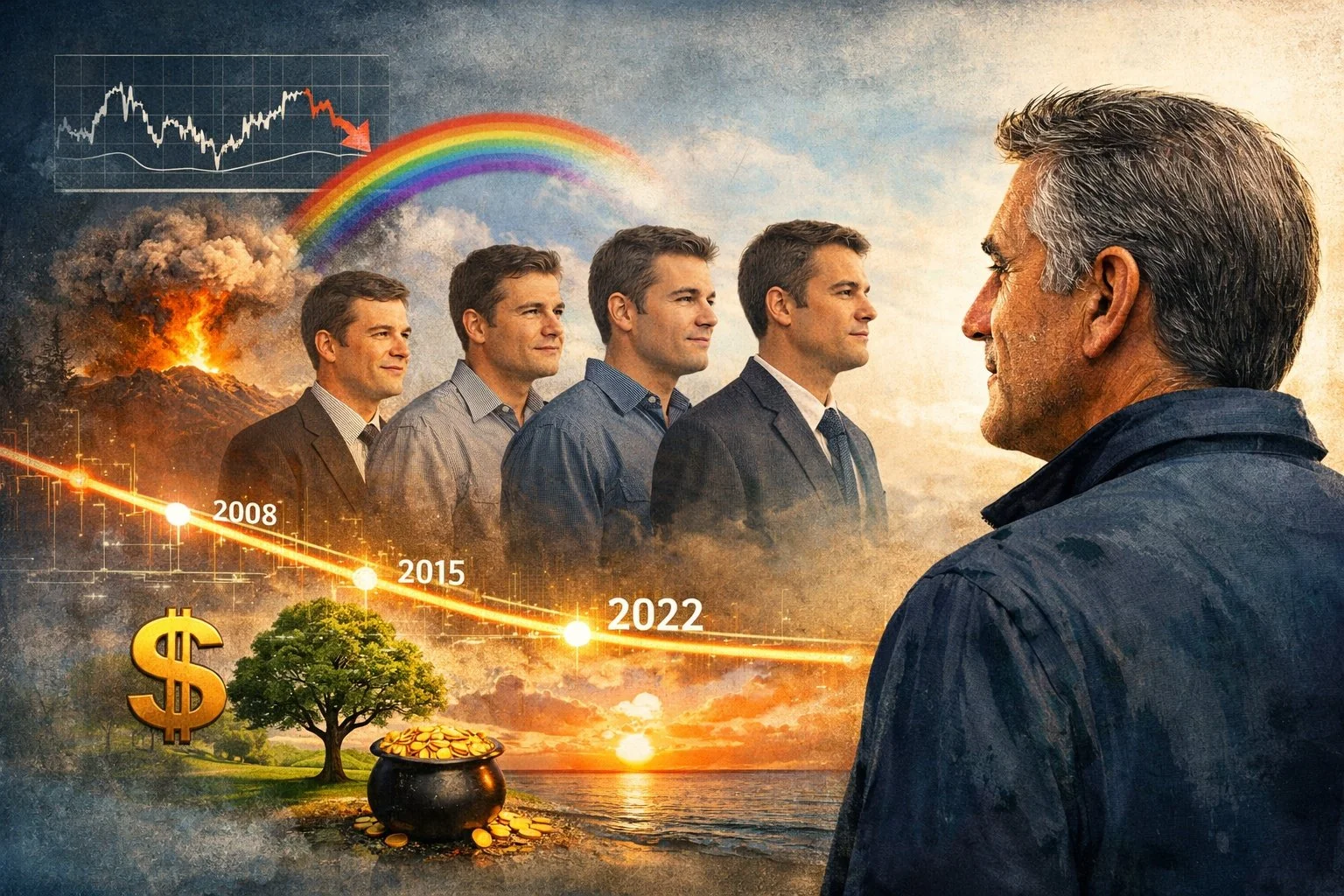
Source: Author’s prompt on ChatGPT
Should I Lighten Up Or Buy The Dip?
Most investors treat each moment as a separate problem to solve. But over time, those decisions don't stay isolated. They stack into patterns and those patterns shape something more important than any single return.
They shape your identity as an investor.
Every market cycle runs the same quiet test. Not of intelligence or information quality but a test of alignment. Do your actions follow a defined process or do they shift based on what just happened? Does a set of principles anchor your decision process or does each new market phase nudge you into slightly different actions?
If you were to look back across a full cycle, most people recognize the pattern more clearly than they expected.
The Patterns Most Investors Fall Into
Some investors drift. In the moment, it feels like adapting and staying flexible while responding to new information. That approach sounds reasonable and often proves reasonable. Over time a pattern starts to form. After strong markets they lean more aggressive. After declines they pull back. Each decision feels right in the moment. When viewed across time, those decisions begin to follow the same rhythm as the market itself. The result rarely appears as one big mistake. It appears as a series of small misalignments that slowly erode returns and confidence.
Others freeze. That often traces back to an experience that left a mark - a sharp loss or a poorly timed decision. From there, the entire focus shifts toward avoiding another mistake. That instinct preserves capital, yes - but it also limits growth. Years pass, markets recover, and opportunities pass by while the portfolio stays anchored in safety. Not because the investor lacks ability, but because the past pain carries more weight than any future gain.
Then there are investors who operate differently. They still feel uncertainty and discomfort, but at some point they made a shift - not about markets beliefs but in how they make decisions. They rely on a defined process with clear rules and actions decided ahead of time. This approach doesn't eliminate doubt but it does change the response to it. Over time, following a systematic approach builds trust in a process - something most investors never fully develop.
These Patterns Show Up In Returns And Beyond
You can see evidence of these patterns in the data. Morningstar's Mind the Gap study shows it year after year - investors tend to underperform the funds they invest in, largely because of timing decisions driven by behavior. But the more meaningful impact shows up beyond the numbers - in how people feel about their progress.
Some investors reach their later working years with a portfolio that hasn't kept pace with what they expected. Others carry ongoing second-guessing, unsure whether to trust their decisions or change course again. They've moved forward in time, but not necessarily in clarity or confidence. And for many, that uncertainty becomes more uncomfortable than any single market decline.
I Recognize This Because I've Lived It
I can see these patterns clearly now because I've been through them. Most of my adult life, I drifted as an investor. During other periods, I have leaned too far toward caution. In both cases, the decisions felt reasonable in the moment, even "prudent".
Looking back now, I can see the cost more clearly - in returns, in time, and in confidence. Those experiences eventually helped force a shift toward a systematic approach.
What Actually Matters Looking Back
For investors in their 50s and 60s, this question becomes more important with each passing year. The next market cycle may bring strong gains, difficult drawdowns, or something in between. We don't control those conditions but we do control how we invest through them.
When people look back ten years from now, they are unlikely to frame the decade in terms of process. They probably won't talk about consistency or discipline in abstract terms. They will ask simpler questions. Did I avoid a loss I couldn't recover from? Did I stay invested when it mattered? Does my portfolio now support the kind of life I want? Did I spend those years worried - or at ease?
That's the scorecard that tends to matter most.
Where You Go From Here
None of us can predict how the next year, let alone decade, will unfold. Markets will do what they do. But we can decide how we respond to them. We can continue "adjusting" a strategy for each phase or stay anchored to past experiences or commit to a defined approach and follow it through a full cycle.
Each path leads somewhere different.
One Way to Think About Moving Forward
A systematic approach offers one way to navigate that uncertainty. Not because it predicts better, but because it removes the need to decide everything in real time. A system helps set actions in advance, creates structure around decisions, and helps align behavior with long-term objectives - especially when emotions want to pull you in different directions.
That's one of the main ideas behind the SmartSignal System. It's a rules-based framework designed to reduce and simplify decisions to once a month and reduce the influence of short-term reactions. It won't fit everyone, and that's perfectly valid. But for investors who recognize these patterns and want a more stable way to move through the next cycle, it provides a clear alternative.
A Final Thought
The next market cycle will come and go, just like the ones before it. When you look back, most of the headlines and day-to-day moves will fade.
What tends to remain is the pattern and the investor you became along the way.
+++++++++++++++++
Want more guidance like this? The Growth Guardian Investor newsletter is free and built for self-directed investors approaching retirement.
Important Disclosures
Past performance does not guarantee future results. Investing involves risk including the possible loss of principal.
The performance shown combines two different kinds of data. Results from January 2003 through December 2024 reflect backtested application of the SmartSignal methodology to historical price data. Results after January 2025 reflect actual signals delivered to subscribers during that period.
Backtested performance has inherent limitations. It does not represent actual trading. Backtested results benefit from hindsight and do not reflect the impact of trading costs, execution slippage, market liquidity, or the psychological pressures of investing real money during live conditions. For these reasons, backtested performance may differ materially from actual results. Individual subscriber results may also vary based on execution timing, account composition, and other factors.
TenHundred Co., its officers, employees, and partners may hold positions in the ETFs or securities referenced by the SmartSignal methodology, and may trade those positions without notice. TenHundred Co. reserves the right to modify or discontinue the methodology at any time, and past performance data may not reflect the current methodology.
Growth Guardian Investor publishes systematic investing education and methodology training under the publisher's exclusion to the Investment Advisers Act of 1940. We do not provide personalized investment advice. Subscribers make their own investment decisions.
Full Disclaimers Statement on www.gginvestor.com.