
Why Return Targets Quietly Sabotage Good Investors
Why Return Targets Quietly Sabotage Good Investors
Returns always look most attractive near market highs.
Yesterday, a young woman on a financial advisor radio show call asked about selling her stock index funds to move into gold. Stocks sit near highs, but gold and silver keep breaking price records almost daily. You can probably understand why she would ask. In moments like these, chasing higher returns doesn't feel reckless: it feels responsible.
This is exactly when optimism sounds most convincing - and when discipline matters most.
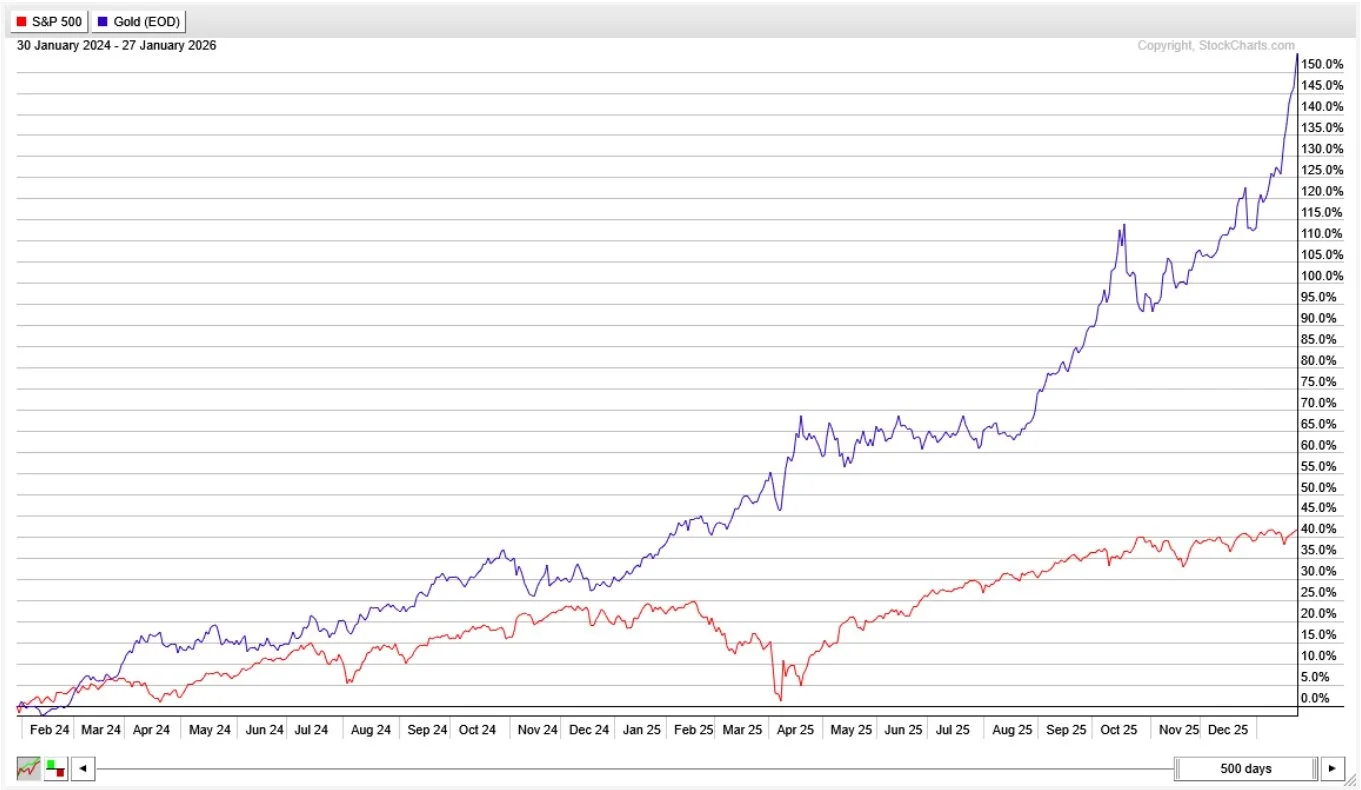
Source:stockcharts.com 2-Year Relative Returns Chart
The Optimism Embedded in Starting With Returns
Here's the familiar internal logic I've run myself. Perhaps you have too:
"I want X% returns. That asset (or strategy) historically experiences Y% drawdowns. That’s larger than anything I've personally lived through... but I'll be able to handle it because those returns justify the pain."
That's a prediction about pain you’ve never felt, not evidence from pain you’ve lived through.
Drawdowns seem theoretical and distant when markets sit near highs. They feel very different when headlines turn dark and you watch your account balance shrink. On paper, a 25% drawdown feels fine - until you hit 15%, your gut tightens, and you worry: "Holy hell, when does this end?”
Here's the thing: wanting the return will not increase your tolerance for the pain required to earn it.
Why Hot Markets Magnify the Risk
Let's back up and ask a different question first. Why does return-first thinking feel especially tempting right now?
Stocks and precious metals are at or near market highs. Do you notice any of these happening?
• Recent gains distort expectations. When assets climb steadily for months or years, our pattern-recognition machinery starts treating continuation as normal and pullbacks as anomalies.
• Volatility feels distant. The VIX might show low readings, but more importantly, your personal memory of stress fades. That 2022 drawdown? A blip. March 2020? Ancient history.
• Loss tolerance expands on paper. You tell yourself you can handle 30% drawdowns because you haven't felt one recently. Your theoretical tolerance grows while your actual tolerance stays unchanged.
Gold and silver provide a useful example here - not because they're special, but because strong trends, compelling narratives, and heavy media attention tend to produce similar behavioral patterns whether we're talking about gold, AI stocks, or anything else climbing hard.
None of that invalidates the assets - but it’s raising the cost of optimism. Entry decisions made near euphoric highs carry asymmetric emotional risk. The higher the enthusiasm, the thinner the margin for error.
What Return-First Thinking Predictably Produces
Watch what happens when returns lead your thinking:
• Risk creep. Drawdowns that seemed unacceptable last year become "part of the process" this year. The goal post moves because you want what's on the other side of it.
• Emotional leverage. The return target becomes pressure instead of motivation. You find yourself checking positions more frequently, feeling anxious when they lag, defensive when someone questions your approach.
• Abandonment at the wrong moment. Most strategies don't break mathematically. But people do. When drawdowns hit harder emotionally than theory predicted, the strategy gets blamed. The real failure happened earlier, when someone optimized for returns - with associated drawdowns that their temperament couldn't sustain.
A Personal Reckoning
For years, my good intentions drove some spreadsheet math - which worked perfectly for those intentions: maximize returns, delay enjoyment, leave all the rest to the kids in the end.
Reading Die with Zero helped me realize the costs I was missing: deferred experiences that never come back, persistent background anxiety masquerading as "staying informed," and living as if "later" carried guarantees the universe never actually made (and did not deliver).
The spreadsheets weren't hiding the costs. They showed up in missed moments and constantly watching markets and positions - the mental habit of treating present life as preparation for future life, indefinitely delayed.
A financial strategy can win while quietly shrinking life. The life you're supposedly building wealth to support.
Why the Tradeoff Changes Over Time
That personal shift in perspective became more urgent as I got closer to actually needing the money. Here's what makes this topic particularly relevant for anyone within 10-15 years of needing their retirement money:
Early in your career, time absorbs big drawdowns - you have decades ahead. Higher returns accelerate progress toward goals still far away.
Later in your career - especially in the financial red zone approaching retirement - the math flips. Time stops cooperating. Sequence of returns risk turns theoretical drawdowns into permanent impairments. A 30% loss at 35 becomes a temporary setback. The same loss at 62 can force you to delay retirement by years.
Of course, returns still matter later, but drawdown size starts dominating the importance of outcomes. That doesn't show up clearly until you're actually living through a drawdown as you approach the date you planned to stop working.
What you could tolerate at 35 can derail plans at 65 - not because you've gotten weaker, but because the territory changed.
Putting Returns in Their Proper Role
So what changes when you flip the order and put returns second?
Returns still matter - but they follow rather than lead. A better decision sequence might look like:
• First: Maximum drawdown you can live through emotionally - not theoretically, but actually, including the 2 AM checking and the conversations with your spouse about whether to "just get out."
• Second: Time horizon you can truly honor, accounting for when you'll actually need the money.
• Third: Real-world constraints - the time you'll spend managing positions, the accounts you're limited to, the tax implications you face.
• Fourth: Returns that fit inside those boundaries.
This matters most right now – late January, 2026 – when asset price ascents look unstoppable. Discipline feels restricting at highs. Later, however, after the cycle turns, everyone who optimized for returns discovers whether their drawdown tolerance was real or imagined.
The Late-Cycle Reminder
Here's what I've found matters more than I expected as a younger investor: not the strategy that looks smartest at tops, but one I can actually follow when markets quit rewarding confidence - when accounts shrink, headlines turn dark, and drawdowns become visceral.
High prices invite optimistic thinking. Optimism expands risk tolerance on paper. Markets test it in your gut.
+++++++++++++++++
To receive helpful information like this for self-directed investors within 10-15 years of retiring, click here for our free weekly newsletter.
Important Disclosures
Past performance does not guarantee future results. Investing involves risk including the possible loss of principal.
The performance shown combines two different kinds of data. Results from January 2003 through December 2024 reflect backtested application of the SmartSignal methodology to historical price data. Results after January 2025 reflect actual signals delivered to subscribers during that period.
Backtested performance has inherent limitations. It does not represent actual trading. Backtested results benefit from hindsight and do not reflect the impact of trading costs, execution slippage, market liquidity, or the psychological pressures of investing real money during live conditions. For these reasons, backtested performance may differ materially from actual results. Individual subscriber results may also vary based on execution timing, account composition, and other factors.
TenHundred Co., its officers, employees, and partners may hold positions in the ETFs or securities referenced by the SmartSignal methodology, and may trade those positions without notice. TenHundred Co. reserves the right to modify or discontinue the methodology at any time, and past performance data may not reflect the current methodology.
Growth Guardian Investor publishes systematic investing education and methodology training under the publisher's exclusion to the Investment Advisers Act of 1940. We do not provide personalized investment advice. Subscribers make their own investment decisions.
Full Disclaimers Statement on www.gginvestor.com.